 blog
7 Ways to Reduce Wildfire Insurance Premiums
Table of Contents
- Why Wildfire Risk Is Driving Insurance Costs Higher
- 1. Create and Maintain Defensible Space Around Your Home
- 2. Invest in Fire-Resistant Home Improvements
- 3. Document Your Mitigation Work and Claim Wildfire Insurance Discounts
- 4. Schedule a Professional Wildfire Insurance Inspection
- 5. Shop Around and Compare Homeowners Insurance Quotes
- 6. Adjust Your Deductible and Coverage Limits Strategically
- 7. Review Your Policy Annually and Take Advantage of New Mitigation Credits
- Frequently Asked Questions
Last Updated: October 20, 2026
Why Wildfire Risk Is Driving Insurance Costs Higher
Wildfire risk has fundamentally changed the homeowners insurance landscape. Insurers are reassessing risk in fire-prone areas, and many homeowners face significant rate increases or policy nonrenewal as catastrophic losses grow.
We help homeowners in high-risk areas reduce wildfire insurance premiums through property mitigation, smart policy choices, and proactive shopping. Most of these steps are actionable today, some cost money upfront but deliver long-term savings, others are free, and all signal to insurers that you take fire risk seriously.
1. Create and Maintain Defensible Space Around Your Home
Defensible space is the most powerful tool you have. It's the area immediately surrounding your home where you remove or reduce vegetation that could fuel a fire.
Here's what defensible space means in practice:
- 0-5 feet from your home: Remove all dead leaves, needles, and branches. Clear gutters and roof valleys. Trim tree branches that hang over the roof. Remove shrubs and small trees entirely.
- 5-30 feet from your home: Space trees so their branches don't touch. Remove lower branches up to 6-10 feet on remaining trees. Thin dense vegetation. Remove dead trees.
- 30-100+ feet from your home: Continue thinning. Remove trees that are diseased or dead. Space remaining trees so crowns don't touch.
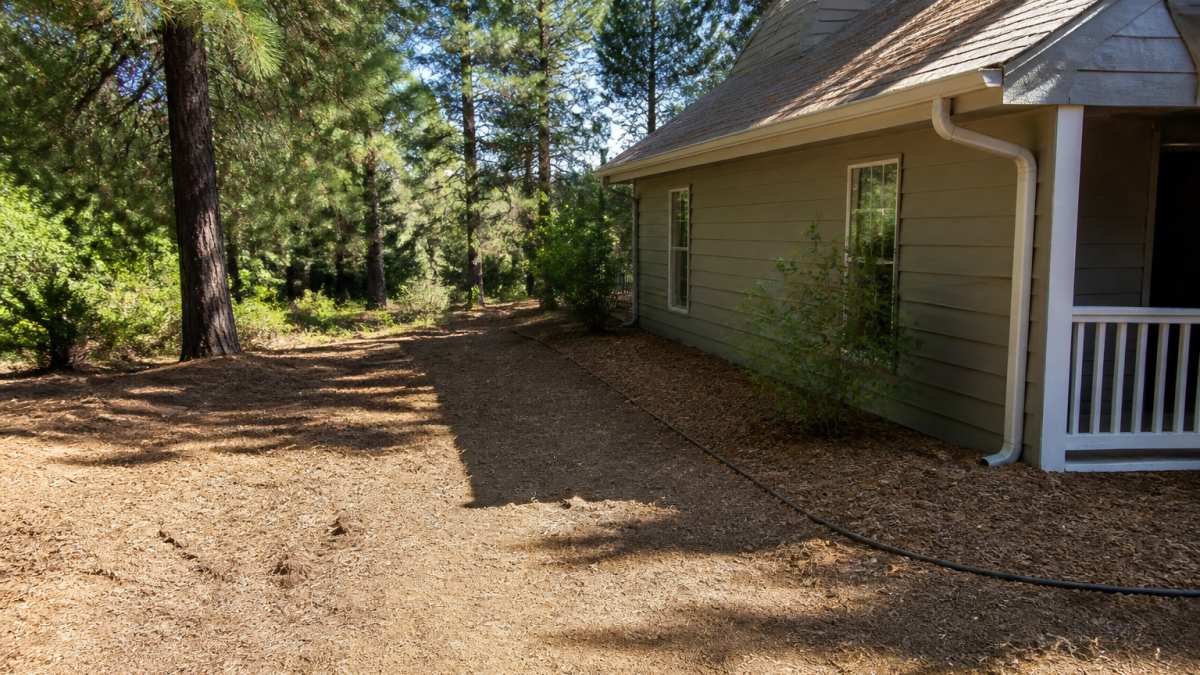
Maintenance is ongoing: spring and fall cleanups are essential because dead material accumulates quickly, and most insurers expect year-round maintenance and will ask about it during inspections.
2. Invest in Fire-Resistant Home Improvements
Fire-resistant materials reduce the chance your home will ignite. Focus on the areas most vulnerable to ember exposure: roof, siding, vents, and gutters.
Priority improvements:
- Roof: Metal or Class A fire-rated asphalt shingles. Avoid wood shakes or shingles.
- Gutters and downspouts: Metal instead of plastic. Keep them clean and ember-free.
- Exterior vents: Install 1/8-inch metal mesh screens to block embers.
Start with the roof if you need to replace it anyway, and spread improvements across years to manage cost. Many qualify for wildfire insurance discounts or mitigation credits.
3. Document Your Mitigation Work and Claim Wildfire Insurance Discounts
Insurers only credit mitigation work they know about, documented in a form the underwriter can verify.
The gap between "I did the work" and "my premium went down" is almost always a documentation gap. Closing it costs little and can unlock credits you already earned.
What insurers typically want to see:
- Date-stamped photos of defensible space, roof, vents, gutters, and siding, taken from angles that show the whole side of the house, not close-ups that could be from any property.
- Receipts or contractor invoices showing the product installed and the date. A Class A roof credit usually requires proof of the rating, not just a new roof.
- A written defensible-space or home-hardening checklist completed by a qualified inspector, if your carrier accepts third-party reports.
How to actually claim the credit:
- Ask the carrier first, not last. Before you spend money, call your agent and ask which specific mitigation measures your carrier credits and what proof each requires. Carriers differ, one may credit ember-resistant vents and another may not, even in the same state.
- Submit a mitigation file, not a phone call. Send photos, receipts, and a one-page summary listing each improvement and its completion date. Ask the agent to attach it to the policy file and confirm in writing that it was received.
- Request a written premium reassessment. Ask the underwriter to re-rate the policy based on the documented mitigation and to confirm the resulting credit in writing. This is the step homeowners skip, and it produces the actual premium change.
- Re-submit at renewal. Credits can fall off the file when a policy is rewritten or moved to a new carrier. Keep your mitigation file and resend it with every renewal and every new quote.
Common wildfire insurance discounts and credits:
- Defensible space maintenance and vegetation management
- Fire-resistant or Class A roof
- Ember-resistant vents and 1/8-inch mesh screening
Discount amounts vary widely by carrier and state, and some carriers fold mitigation into their base rate rather than listing it as a separate credit.
If your carrier says it does not credit a measure you completed, ask whether a different carrier would. Mitigation credits are one of the few areas where shopping actually changes the answer, not just the price.
4. Schedule a Professional Wildfire Insurance Inspection
Many insurers require an inspection before offering coverage in high-risk areas. Some are routine; others determine whether you'll be accepted at all.
A professional inspection evaluates your property's fire risk, checking defensible space, roof condition, siding, vents, and surrounding vegetation for hazards like dead trees, dense brush, or proximity to wildland areas.
What to do before an inspection:
- Clear gutters and roof valleys
- Remove dead branches and vegetation within 30 feet
- Trim tree branches hanging over the roof
An inspection is an opportunity, not a threat: it shows the insurer you take fire risk seriously and gives you concrete feedback on what to prioritize next.
If the inspection identifies problems, address what you can. You don't need to fix everything immediately, but showing progress matters.
5. Shop Around and Compare Homeowners Insurance Quotes
One of the most effective ways to reduce wildfire insurance premiums is to shop around. Insurance rates vary significantly between carriers, even for identical homes in the same area.
Different insurers have different risk appetites. Some specialize in high-risk properties. Others focus on lower-risk areas. Some value your mitigation efforts more than others.
How to compare quotes effectively:
- Request quotes from at least 3-5 carriers
- Use the same coverage limits and deductibles for each quote
- Ask each insurer about available wildfire discounts
Don't compare price alone. Consider financial strength, claims reputation, and willingness to work in high-risk areas, a slightly higher premium from a stable, responsive carrier often beats a low quote from an insurer that cancels policies aggressively.
Fadaie Insurance Services, Inc. works with multiple carriers to find competitive rates for homeowners with wildfire exposure. We handle the comparison work for you, providing multiple quotes and recommendations based on your specific situation.
6. Adjust Your Deductible and Coverage Limits Strategically
Raising your deductible or trimming coverage lowers your premium. The hard part is comparing equivalent policies, so you don't reduce price by quietly weakening the protection you're paying for.
A lower quote is only meaningful if it covers the same house, perils, and rebuild cost. Compare policies line by line before comparing premiums.
The deductible decision:
- Standard deductible: Usually $500 or $1,000. Lowest out-of-pocket at claim time, highest premium.
- Higher deductible: $2,500 or $5,000 lowers premiums meaningfully, but only makes sense if you have that cash set aside and could still rebuild after a loss.
- Wildfire-specific deductible: Many policies in high-risk areas now carry a separate wildfire deductible, often expressed as a percentage of the dwelling limit rather than a flat dollar amount. A 1% wildfire deductible on a $500,000 dwelling is $5,000, read the policy form, not just the declarations page summary.
How to compare equivalent policies, not just quoted premiums:
- Match the dwelling limit to rebuild cost, not market value. Ask each carrier how it arrived at the dwelling limit and whether it uses a replacement-cost estimator. A low dwelling limit is the most common way a cheap quote hides underinsurance.
- Confirm replacement cost vs. actual cash value. Replacement cost pays to rebuild at current construction costs; actual cash value subtracts depreciation. A policy quoted on actual cash value will look cheaper and leave you short after a total loss.
- Check for guaranteed replacement cost or extended replacement cost. These endorsements pay above the dwelling limit if construction costs spike after a disaster, common after widespread wildfires when labor and materials are scarce.
- Read the wildfire deductible and any separate wind or fire deductible. Compare the dollar exposure at your limit, not the percentage.
- Review exclusions and sublimits. Look for exclusions on debris removal, landscaping, outbuildings, and additional living expenses, and check whether any sublimits are too low to rebuild.
- Ask about nonrenewal and cancellation practices. A carrier that aggressively nonrenews in high-risk areas can leave you shopping under pressure at the worst time. Ask how the carrier has handled renewals in your area.
- Compare the claims process. Ask how the carrier handles wildfire claims, whether it uses adjusters experienced with wildfire losses, and how it pays additional living expenses.
Review coverage limits every 2-3 years. Construction costs and home values change, and a dwelling limit set three years ago may no longer rebuild the same house. Underinsurance is a silent risk you don't notice until you file a claim.
7. Review Your Policy Annually and Take Advantage of New Mitigation Credits
Insurance isn't set-it-and-forget-it. Your risk profile changes, mitigation efforts accumulate, and new discounts emerge. Annual reviews ensure you're not leaving money on the table.
Annual review checklist:
- Check your coverage limits against your home's current replacement cost
- List any mitigation work completed since last renewal
- Ask about new discounts or programs your insurer offers
Each year, your maintenance, improvements, and mitigation credits accumulate, and insurers may recognize new credits, launch new programs, or adjust risk models.
Fadaie Insurance Services, Inc. offers annual policy reviews to help homeowners stay current with their coverage and capture available discounts. We track mitigation work and communicate it to insurers on your behalf.
Wildfire risk is real, but your response doesn't have to be passive.
Fadaie Insurance Services, Inc. coordinates mitigation efforts with your insurance strategy, tracking improvements, communicating them to carriers, and comparing quotes to ensure you get the best rate for your risk profile.
Frequently Asked Questions
How can I lower my wildfire insurance premium without sacrificing coverage?
Start with defensible space: clear brush and dead trees within 30 feet of your home, trim lower branches 6-10 feet up the trunk, and remove leaves from gutters. Next, invest in fire-resistant materials for your roof and siding, many insurers offer discounts when you complete these upgrades. Document all work with photos and receipts, then contact your insurer about mitigation credits. Finally, shop quotes from multiple carriers; rates vary significantly based on how each insurer evaluates wildfire risk and recognizes mitigation efforts.
Do wildfire mitigation discounts apply automatically to my policy?
No. Most insurers require you to request a reassessment or inspection after completing mitigation work. Some offer discounts only if you submit documentation, photos, contractor invoices, or a professional mitigation report. A few carriers automatically apply credits when they inspect your property, but this is uncommon. Contact your agent or insurer directly after finishing any home hardening or defensible space work to ask what proof they need and how to trigger the discount.
What home improvements have the biggest impact on wildfire insurance costs?
Roof replacement with Class A fire-rated materials and ember-resistant vents offer the largest premium reductions, often 5-15% depending on your insurer. Box in eaves, install metal gutters, and upgrade siding to fire-resistant materials for additional credits. Exterior sprinkler systems designed for ember protection also qualify for discounts with many carriers. Combination projects, such as a new roof plus defensible space plus ember vents, can stack discounts and produce savings of 20-30%, though the exact reduction varies by carrier and your current risk profile.
How do I compare homeowners insurance quotes fairly when wildfire risk is involved?
Request identical coverage limits, deductibles, and policy terms from at least three carriers so you're comparing apples to apples. Ask each insurer specifically which mitigation measures they recognize and what discount percentage each qualifies for. Confirm whether they're quoting you as a new customer or if they apply loyalty discounts. Get the quote in writing and ask about any conditions, some carriers may non-renew after a claim or in high-risk areas. An independent agent can pull multiple quotes at once and explain how each insurer's underwriting differs in your area.